Showing posts with label O'Reilly Media e-books. Show all posts

Thursday, February 11, 2010

Volume 6B: Motif Reference Manual


The Motif Reference Manual is a complete programmer's reference for the Motif toolkit from the Open Software Foundation (OSF). Motif has become the standard user interface for X Window System applications, and the Motif toolkit makes it easy for programmers to build applications that conform with the Motif "look and feel."
Dan Heller's Motif Programming Manual has long been considered the most authoritative and insightful work on Motif. Now, with the addition of this companion reference manual, programmers can dispense completely with the original OSF documentation. In addi- tion to covering the entire Motif toolkit, this book also covers OSF's "User Interface Language" or UIL, and the Motif Resource Manager (MRM) functions used to tie together applications with user interfaces defined in UIL.
Contents include:
  • Reference pages for all of the Motif functions and macros.
  • Reference pages for the widget classes defined by the Motif toolkit and the X Toolkit Intrinsics.
  • Reference pages for the Motif Resource Manager (Mrm) functions that are used in conjunction with UIL.
  • Reference pages for the Motif clients: mwm, uil, and xmbind.
  • Reference pages that describe the file format of a User Interface Language module.
  • Reference pages for the data types supported by UIL.
  • Reference pages for the User Interface Language functions.
  • A permuted index and a regular index.
  • A number of appendices and quick reference aids including a list of new functions, widget classes, and widget resources in Motif 1.2.
This book is designed to be used with Volume 6A, Motif Programming Manual, which describes how to build applications using the Motif toolkit and provides a complete tutorial with programming examples. Both of the books are an integral part of the X Window System series from O'Reilly & Associates, Inc.

http://depositfiles.com/files/jj96ifouy
http://www.megaupload.com/?d=LW3POON0

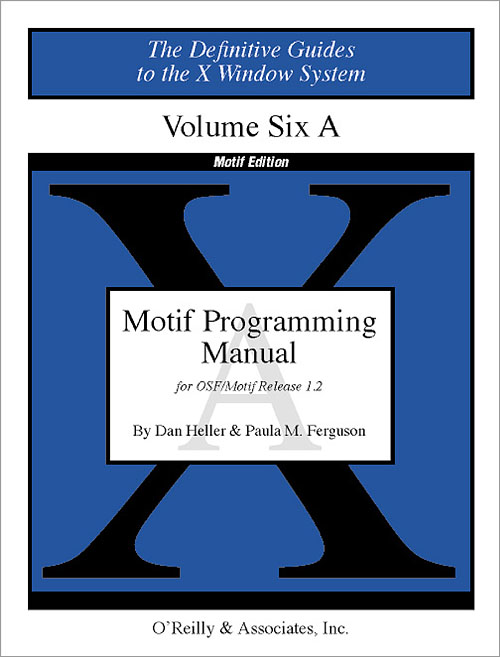
Motif Programming Manual, Vol 6A, Second Edition

The Motif Programming Manual is a source for complete, accurate, and insightful guidance on Motif application programming. There is no other book that covers the ground as thoroughly or as well as this one. The book has been updated to Motif 1.2, but is still usable with Motif 1.1.
The Motif Programming Manual describes how to write applications using the Motif toolkit from the Open Software Foundation (OSF). The book goes into detail on every Motif widget class, with useful examples that will help programmers to develop their own code. Anyone doing Motif programming who doesn't want to have to figure it out on their own needs this book.
In addition to information on Motif, the book is full of tips about programming in general and about user interface design.
Contents include:
  • An introduction to the Motif programming model, how it is based on the X Toolkit Intrinsics, and how it differs from them.
  • Chapters on each of the Motif widget classes, explaining them in depth, with useful examples that will help you to improve your own code. For example, the chapter on menus shows how to develop utility functions that generalize and simplify menu creation. All of the code shown in the book is available free of charge over the Internet or via UUCP.
  • Coverage of the drag-and-drop mechanism for transferring data. Two extensive examples show how to implement custom drag source and drop site functionality in a Motif application.
  • A tutorial on UIL. The chapters on UIL describe all of the techniques used to create an interface with this prototyping tool. The numerous examples cover the basics and explore ways to use UIL to facilitate rapid prototyping.
  • ,/ul> The book assumes competence with the C programming language, as well as familiarity with fundamental X Window System concepts. The Motif Programming Manual is not only the most comprehensive guide to writing applications with Motif, it is an integral part of the most widely used series of books on X as a whole. It complements and builds upon the earlier books in the X Window System Series from O'Reilly & Associates, as well as on OSF's own Motif Style Guide. Best when paired with Volume 6B, Motif Reference Manual.


http://depositfiles.com/files/8488z45li
http://www.megaupload.com/?d=8DL8BI37

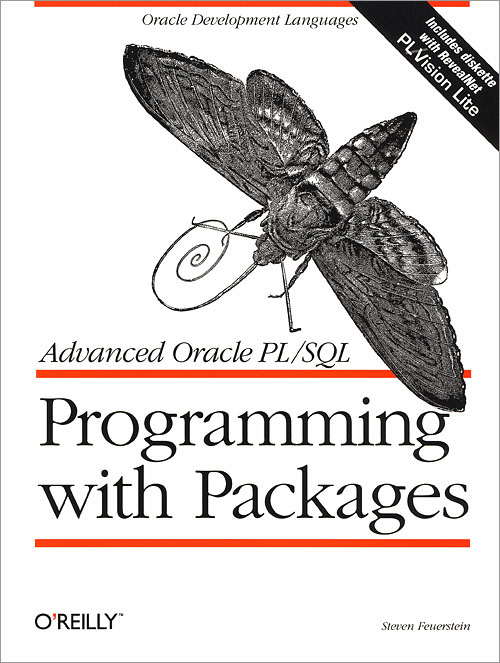
Advanced Oracle PL/SQL Programming with Packages

Steven Feuerstein's first book, Oracle PL/SQL Programming, has become the classic reference to PL/SQL, Oracle's procedural extension to its SQL language. His new book looks thoroughly at one especially advanced and powerful part of the PL/SQL language -- the package. The use of packages can dramatically improve your programming productivity and code quality, while preparing you for object-oriented development in Oracle technology. In this book, Feuerstein explains how to construct packages -- and how to build them the right way. His "best practices" for building packages will transform the way you write packages and help you get the most out of the powerful, but often poorly understood, PL/SQL language.
Much more than a book, Advanced Oracle PL/SQL Programming with Packages comes with a PC diskette containing a full-use software companion. Developed by Feuerstein, RevealNet's PL/Vision Lite is the first of its kind for PL/SQL developers: a library of thirty-plus PL/SQL packages. The packages solve a myriad of common programming problems and vastly accelerate the development of modular and maintainable applications.
The packages provided in PL/Vision Lite fall into three categories:
  • Building block packages: low-level development enhancers, including string parsers, a list manager, and an interface to PL/SQL tables.
  • Developer utilities: programs that improve your PL/SQL development environment, including a code generator, a powerful substitute for SHOW ERRORS, and an online help delivery mechanism.
  • Plug-and-play components: pieces of code that can be used as is in your own applications, including a high-level exception handler mechanism and a generic, reusable logging mechanism.
In addition to describing the details of these packages, this book explores why and how they were built the way they were. You'll come away with an increased appreciation of the PL/SQL language and the power of packages. Most importantly, you'll be ready and eager to put that power to use immediately in your own applications.

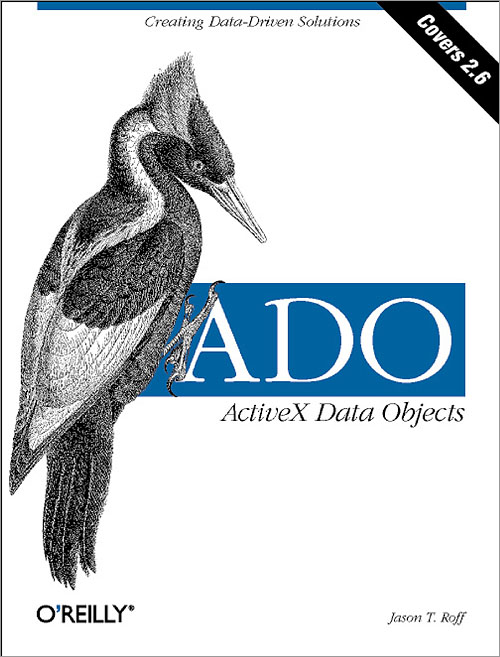
ADO: ActiveX Data Objects

Getting data across platforms and formats is a cornerstone of present-day applications development. ADO: ActiveX Data Objects is both an introduction and a complete reference to ADO (ActiveX Data Objects), Microsoft's universal data access solution. You'll learn how to easily access data in multiple formats--such as email messages, Access databases, Word documents, and SQL databases--even on different platforms, without spending extra time learning every last detail about each format.
Author Jason Roff shows by example how to use ADO with your programming language of choice to save programming time, so you can concentrate on the content and quality of your application rather than the nitty-gritty of specific data formats.
ADO: ActiveX Data Objects includes:
  • Chapters dedicated to the Connection, Recordset, Field, and Command objects and the Properties collection
  • A complete, detailed reference listing every ADO object, method, property, and event, in convenient alphabetical order
  • Chapters on ADO architecture, data shaping, the ADO Event Model
  • An appendix containing enumeration tables used by ADO objects and collections, listed alphabetically
  • Brief introductions to RDS, ADO.NET, and SQL
ADO: ActiveX Data Objects is a versatile one-stop guide to both the theory and practice of programming with ADO through Version 2.6. The thorough reference section and topic-specific chapters will help you find quick answers about the details of objects, collections, methods, and properties of ADO. And the abundance of practical code examples will give you a good grasp of how to use ADO's strong points most effectively.


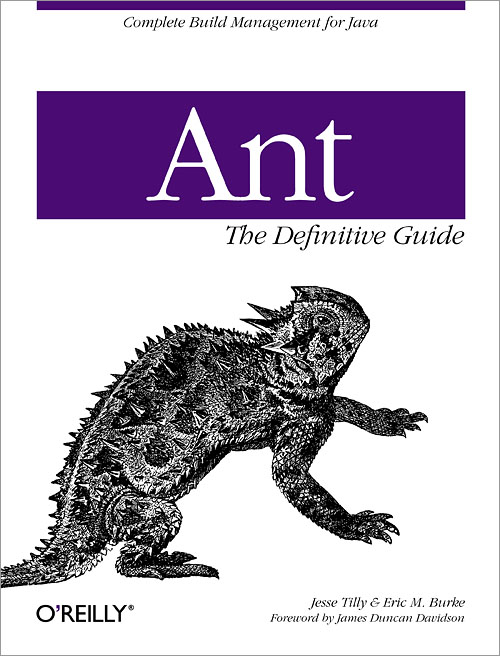
Ant: The Definitive Guide

Ant is the premiere build management tool for use in Java environments. Unlike traditional build management tools such as GNU Make, Ant is itself written in Java, is platform independent, and interfaces well with the utilities in Sun's Java software development kit (SDK). In addition to being platform independent, Ant is also independent of the integrated development environment (IDE) being used. IDE independence is important for open source projects (or other projects) in which the various developers might use different IDEs. Using Ant, Java developers can:
  • Define build chunks, the results that they must produce, and the dependencies between them
  • Automatically retrieve source code from source control systems such as PVCS
  • Build applications by having Ant compile the necessary source files in the proper order
Ant build files are written using XML-a well-established standard-so programmers using Ant are not required to learn yet another scripting language. They will likely already know XML, and will be able to leverage that knowledge. Ant is an open source project, and part of the Jakarta project. Jakarta is Sun's open source reference implementation for the JSP and Servlets specifications, and is part of the Apache group's work


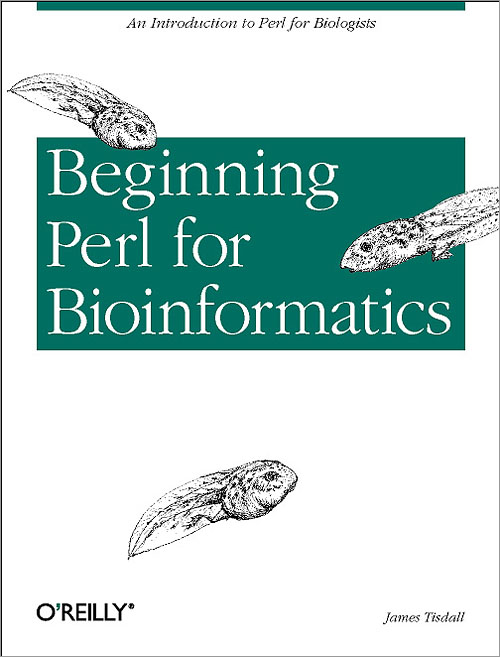
Beginning Perl for Bioinformatics

With its highly developed capacity to detect patterns in data, Perl has become one of the most popular languages for biological data analysis. But if you're a biologist with little or no programming experience, starting out in Perl can be a challenge. Many biologists have a difficult time learning how to apply the language to bioinformatics. The most popular Perl programming books are often too theoretical and too focused on computer science for a non-programming biologist who needs to solve very specific problems.
Beginning Perl for Bioinformatics is designed to get you quickly over the Perl language barrier by approaching programming as an important new laboratory skill, revealing Perl programs and techniques that are immediately useful in the lab. Each chapter focuses on solving a particular bioinformatics problem or class of problems, starting with the simplest and increasing in complexity as the book progresses. Each chapter includes programming exercises and teaches bioinformatics by showing and modifying programs that deal with various kinds of practical biological problems. By the end of the book you'll have a solid understanding of Perl basics, a collection of programs for such tasks as parsing BLAST and GenBank, and the skills to take on more advanced bioinformatics programming. Some of the later chapters focus in greater detail on specific bioinformatics topics. This book is suitable for use as a classroom textbook, for self-study, and as a reference.
The book covers:
  • Programming basics and working with DNA sequences and strings
  • Debugging your code
  • Simulating gene mutations using random number generators
  • Regular expressions and finding motifs in data
  • Arrays, hashes, and relational databases
  • Regular expressions and restriction maps
  • Using Perl to parse PDB records, annotations in GenBank, and BLAST output


Java Server Pages


JavaServer Pages (JSP) technology provides an easy way to create dynamic web pages. JSP uses a component-based approach that allows web developers to easily combine static HTML for look-and-feel with Java components for dynamic features. The simplicity of this component-based model, combined with the cross-platform power of Java, allows a web development environment with enormous potential.
JavaServer Pages shows how to develop Java-based web applications without having to be a hardcore programmer. The author provides an overview of JSP concepts and discusses how JSP fits into the larger picture of web applications. Web page authors will benefit from the chapters on generating dynamic content, handling session information, accessing databases, authenticating users, and personalizing content. In the programming-oriented chapters, Java programmers learn how to create Java components and custom JSP tags for web authors to use in JSP pages.


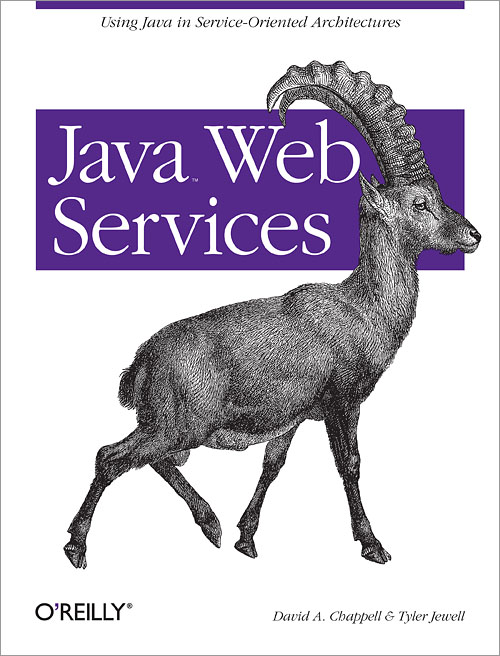
Java Web Services

For many Java developers, web services appeared to come out of nowhere. Its advantages are clear: web services are platform-independent (like Java itself), language-agnostic (a clear advantage over Java RMI), can easily be tunneled through firewalls (an obvious benefit to anyone who has dealt with modern enterprise networks), object-oriented (we all know about that), and tends to be loosely coupled (allowing more flexible application development). But these advantages have been obscured by a cloud of hype and a proliferation of jargon that are difficult to penetrate. What are SOAP, UDDI, WSDL, and JAXM? To say nothing of JAXR, tModels, category bags, WSFL, and other friends? And assuming that you understand what they are, how do you do anything with them? Do they live up to their promises? Are they really the future of network computing, or a dead end?
Java Web Services gives the experienced Java developer a way into the Web Services world. It helps you to understand what's going on, what the technologies mean and how they relate, and shows Java developers how to put them to use to solve real problems. You'll learn what's real and what isn't; what the technologies are really supposed to do, and how they do it. Java Web Services shows you how to use SOAP to perform remote method calls and message passing; how to use WSDL to describe the interface to a web service or understand the interface of someone else's service; and how to use UDDI to advertise (publish) and look up services in each local or global registry. Java Web Services also discusses security issues, interoperability issues, integration with other Java enterprise technologies like EJB; the work being done on the JAXM and JAX-RPC packages, and integration with Microsoft's .NET services.
The web services picture is still taking shape; there are many platforms and APIs to consider, and many conflicting claims from different marketing groups. And although web services are inherently language-independent, the fit between the fundamental principles on which Java and web services are based means that Java will almost certainly be the predominant language for web services development. If you're a Java developer and want to climb on the web services bandwagon, or if you only want to "kick the tires" and find out what web services has to offer, you will find this book indispensable.

Mastering Regular Expressions

Regular expressions are a powerful tool for manipulating text and data. If you don't use them yet, you will discover in this book a whole new world of mastery over your data. If you already use them, you'll appreciate this book's unprecedented detail and breadth of coverage. If you think you know all you need to know about regular expressions, this book is a stunning eye-opener.
With regular expressions, you can save yourself time and aggravation while dealing with documents, mail messages, log files -- you name it -- any type of text or data. For example, regular expressions can play a vital role in constructing a World Wide Web CGI script, which can involve text and data of all sorts.
Regular expressions are not a tool in and of themselves, but are included as part of a larger utility. The classic example is grep. These days, regular expressions can be found everywhere, such as in:
  • Scripting languages (including Perl, Tcl, awk, and Python)
  • Editors (including Emacs, vi, and Nisus Writer)
  • Programming environments (including Delphi and Visual C++)
While many of these tools originated on UNIX, they are now available for a wide variety of platforms, including DOS/Windows and MacOS, so you can use them in your home environment. Additionally, many favorite programming languages offer regular-expression libraries, so you can include support for them in your own programs, and yes, even applets.
There can be certain subtle, but valuable, ways to think when you're using regular expressions, and these can be taught. Jeffrey Friedl has spent years helping people on the Net understand and use regular expressions. In this book he leads you through the steps of knowing exactly how to craft a regular expression to get the job done.
Regular expressions are not used in a vacuum. In this book, a variety of tools are examined and used in an extensive array of examples, with a major focus on Perl. Perl is extremely well endowed with rich and expressive regular expressions. Yet what is power in the hands of an expert can be fraught with peril for the unwary. This book will help you navigate the minefield to becoming an expert.

MCSE: Windows 2000 Exams in a Nutshell

Microsoft's MCSE (Microsoft Certified Systems Engineer) candidates in the Windows 2000 track are required to pass five core exams and two elective exams. These exams are designed to provide a valid and reliable measure of competency for experienced IT professionals working in the typically complex computing environment of medium to large organizations.
MCSE in a Nutshell: The Windows 2000 Exams is a comprehensive study guide and detailed quick reference that covers the following exams:
  • Exam 70-210: Installing, Configuring, and Administering Microsoft Windows 2000 Professional
  • Exam 70-215: Installing, Configuring, and Administering Microsoft Windows 2000 Server
  • Exam 70-216: Implementing and Administering a Microsoft Windows 2000 Network Infrastructure
  • Exam 70-217: Implementing and Administering a Microsoft Windows 2000 Directory Services Infrastructure
  • Exam 70-219: Designing a Microsoft. Windows. 2000 Directory Services Infrastructure
  • Exam 70-221: Designing a Microsoft. Windows. 2000 Network Infrastructure
  • Exam 70-220: Designing Security for a Microsoft. Windows. 2000 Network
Each chapter covers one exam. It includes:
  • A summary of the key areas covered by the exam
  • A description of the format, difficulty of each exam and tips for passing it
  • Definitions of key terms
Any administrator who is serious about acquiring MCSE certification will find this book indispensable. MCSE in a Nutshell: The Windows 2000 Exams is the best value on the market, combining a low price and fast pace that will appeal to sophisticated users who need a bridge between real-world experience and the MCSE Exam requirements.

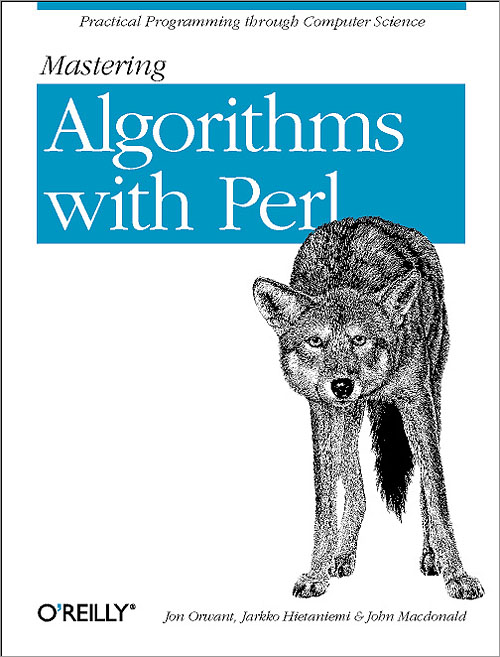
Mastering Algorithms with Perl

Many programmers would love to use Perl for projects that involve heavy lifting, but miss the many traditional algorithms that textbooks teach for other languages. Computer scientists have identified many techniques that a wide range of programs need, such as:
  • Fuzzy pattern matching for text (identify misspellings!)
  • Finding correlations in data
  • Game-playing algorithms
  • Predicting phenomena such as Web traffic
  • Polynomial and spline fitting
Using algorithms explained in this book, you too can carry out traditional programming tasks in a high-powered, efficient, easy-to-maintain manner with Perl.
This book assumes a basic understanding of Perl syntax and functions, but not necessarily any background in computer science. The authors explain in a readable fashion the reasons for using various classic programming techniques, the kind of applications that use them, and -- most important -- how to code these algorithms in Perl.
If you are an amateur programmer, this book will fill you in on the essential algorithms you need to solve problems like an expert. If you have already learned algorithms in other languages, you will be surprised at how much different (and often easier) it is to implement them in Perl. And yes, the book even has the obligatory fractal display program.
There have been dozens of books on programming algorithms, some of them excellent, but never before has there been one that uses Perl.
The authors include the editor of The Perl Journal and master librarian of CPAN; all are contributors to CPAN and have archived much of the code in this book there.
"This book was so exciting I lost sleep reading it." Tom Christiansen

Thursday, February 04, 2010

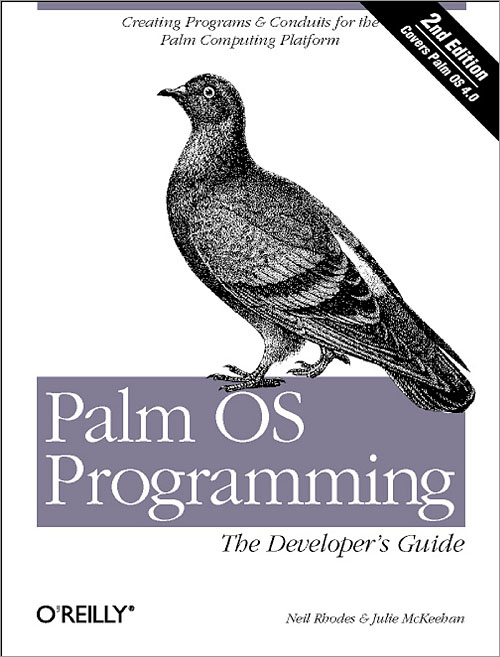
Palm Programming: The Developer's Guide


PalmPilot's popularity is growing and with over a million units sold, the Palm OS dominates the hand-held market. Wired has astutely described Palm's position in a recent article: "On its way to becoming the bestselling hand-held computer of all time, the 3Com PalmPilot has spawned an intense, emotional, and fanatical developer following not seen since the glory days of the Mac." (Wired, 20 Feb. 98). Palm Programming should be eagerly accepted by programmers because the authors worked closely with Palm to ensure that the book is tailored exactly to the needs of the ever-growing group of Palm developers. As nothing but some piecemeal documentation exists currently, this book provides a much needed solution to the Palm developers. In fact, Palm uses this book as their official developer's guide and will be using it in the future as a key part of their training materials for developers. There are currently no books on Palm programming (and we know of none that are planned). The only way to learn is by using the reference material published by Palm (available freely on their Web site), the tutorial they provide, or various Palm programming FAQs compiled by third parties. Palm Programming shows intermediate to experienced C programmers how to build a Palm application from the ground up. Using an easy-to- understand tutorial approach, this book gives readers everything necessary to create a wide range of Palm applications and conduits, from simple scripts through full-blown applications, and in the process provides thorough coverage of Palm programming. It includes a CD-ROM (Macintosh and Windows compatible) with the full source code to the examples in the book, a trial version of Palm's Software Development Kit, and third-party developer tools, including Metrowerks' CodeWarrior Lite programming kit. Outline Part 1: Overview of Palm OS and devices Chapter 1: The Palm Solution Chapter 2: Developing for Palm OS Chapter 3: Designing a solution Part 2: Programming for the handheld Chapter 4: Structure of an Application Chapter 5: Forms and Form Objects Chapter 6: Databases Chapter 7: Menus Chapter 8: Extras Chapter 9: Communications Chapter 10: Debugging Part 3: Programming for the desktop: conduits Chapter 11: Getting started with conduits Chapter 12: Uploading and Downloading Data Chapter 13: Two-way Syncing Appendix: Where to go from here

[Click for More]

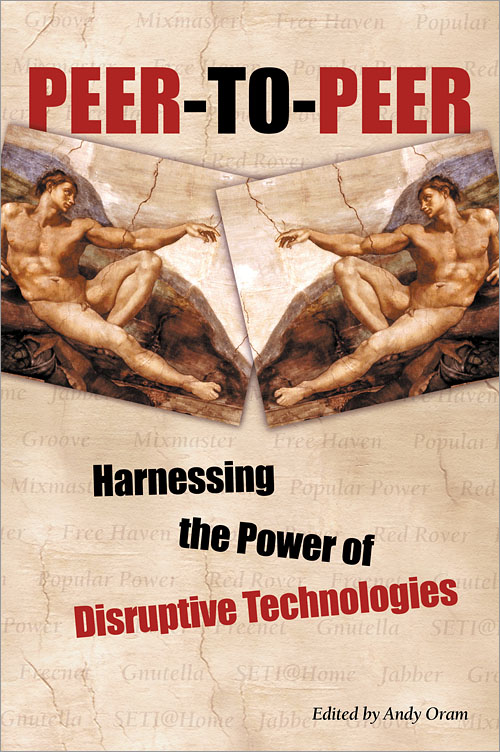
Peer-to-Peer

The term "peer-to-peer" has come to be applied to networks that expect end users to contribute their own files, computing time, or other resources to some shared project. Even more interesting than the systems' technical underpinnings are their socially disruptive potential: in various ways they return content, choice, and control to ordinary users.
While this book is mostly about the technical promise of peer-to-peer, we also talk about its exciting social promise. Communities have been forming on the Internet for a long time, but they have been limited by the flat interactive qualities of email and Network newsgroups. People can exchange recommendations and ideas over these media, but have great difficulty commenting on each other's postings, structuring information, performing searches, or creating summaries. If tools provided ways to organize information intelligently, and if each person could serve up his or her own data and retrieve others' data, the possibilities for collaboration would take off. Peer-to-peer technologies along with metadata could enhance almost any group of people who share an interest--technical, cultural, political, medical, you name it.
This book presents the goals that drive the developers of the best-known peer-to-peer systems, the problems they've faced, and the technical solutions they've found. Learn here the essentials of peer-to-peer from leaders of the field:
  • Nelson Minar and Marc Hedlund of target="new">Popular Power, on a history of peer-to-peer
  • Clay Shirky of acceleratorgroup, on where peer-to-peer is likely to be headed
  • Tim O'Reilly of O'Reilly & Associates, on redefining the public's perceptions
  • Dan Bricklin, cocreator of Visicalc, on harvesting information from end-users
  • David Anderson of SETI@home, on how SETI@Home created the world's largest computer
  • Jeremie Miller of Jabber, on the Internet as a collection of conversations
  • Gene Kan of Gnutella and GoneSilent.com, on lessons from Gnutella for peer-to-peer technologies
  • Adam Langley of Freenet, on Freenet's present and upcoming architecture
  • Alan Brown of Red Rover, on a deliberately low-tech content distribution system
  • Marc Waldman, Lorrie Cranor, and Avi Rubin of AT&T Labs, on the Publius project and trust in distributed systems
  • Roger Dingledine, Michael J. Freedman, and David Molnar of Free Haven, on resource allocation and accountability in distributed systems
  • Rael Dornfest of O'Reilly Network and Dan Brickley of ILRT/RDF Web, on metadata
  • Theodore Hong of Freenet, on performance
  • Richard Lethin of Reputation Technologies, on how reputation can be built online
  • Jon Udell of BYTE and Nimisha Asthagiri and Walter Tuvell of Groove Networks, on security
  • Brandon Wiley of Freenet, on gateways between peer-to-peer systems
You'll find information on the latest and greatest systems as well as upcoming efforts in this book.


[Click for More]

Python & XML

If you are a Python programmer who wants to incorporate XML into your skill set, this is the book for you. Python has attracted a wide variety of developers, who use it either as glue to connect critical programming tasks together, or as a complete cross-platform application development language. Yet, because it is object-oriented and has powerful text manipulation abilities, Python is an ideal language for manipulating XML.
Python & XML gives you a solid foundation for using these two languages together. Loaded with practical examples, this new volume highlights common application tasks, so that you can learn by doing. The book starts with the basics then quickly progresses to complex topics, like transforming XML with XSLT, querying XML with XPath, and working with XML dialects and validation. It also explores the more advanced issues: using Python with SOAP and distributed web services, and using Python to create scalable streams between distributed applications (like databases and web servers).
The book provides effective practical applications, while referencing many of the tools involved in XML processing and Python, and highlights cross-platform issues along with tasks relevant to enterprise computing. You will find ample coverage of XML flow analysis and details on ways in which you can transport XML through your network.
Whether you are using Python as an application language, or as an administrative or middleware scripting language, you are sure to benefit from this book. If you want to use Python to manipulate XML, this is your guide.


[Click for More]

Wednesday, February 03, 2010

Server Load Balancing


Load balancing improves network performance by distributing traffic efficiently so that individual servers are not overwhelmed by sudden fluctuations in activity. Server Load Balancing is a guide to this critical component of high availability, clustering, and fault tolerance, all of which provide the infrastructure for reliable Internet sites and large corporate networks.
Much of the information on load balancing comes from vendor-specific manuals that use inconsistent terminology and are often biased toward the products they cover. Server Load Balancing explains to engineers and technicians the concepts and terminology of load balancing and offers practical guidance for planning and implementing it in almost any environment. It includes a configuration guide with diagrams and sample configurations for installing, configuring, and maintaining products from the four major vendors:
  • Alteon WebSystems
  • Cisco's CSS Series (formerly ArrowPoint)
  • F5's BIG-IP
  • the Foundry ServerIron series
By comparing several load balancing products, you'll gain a deeper understanding of the technology and how best to use it to improve your network performance. No system administrator responsible for traffic management should be without this practical guide.


[Click for More]

Apache: The Definitive Guide


Apache is far and away the most widely used web server platform in the world. This versatile server runs more than half of the world's existing web sites. Apache is both free and rock-solid, running more than 21 million web sites ranging from huge e-commerce operations to corporate intranets and smaller hobby sites.
With this new third edition of Apache: The Definitive Guide, web administrators new to Apache will come up to speed quickly, and experienced administrators will find the logically organized, concise reference sections indispensable, and system programmers interested in customizing their servers will rely on the chapters on the API and Apache modules.
Updated to cover the changes in Apache's latest release, 2.0, as well as Apache 1.3, this useful guide discusses how to obtain, set up, secure, modify, and troubleshoot the Apache software on both Unix and Windows systems. Dozens of clearly written examples provide the answers to the real-world issues that Apache administrators face everyday. In addition to covering the installation and configuration of mod_perl and Tomcat, the book examines PHP, Cocoon, and other new technologies that are associated with the Apache web server. Additional coverage of security and the Apache 2.0 API make Apache: The Definitive Guide, Third Edition essential documentation for the world's most popular web server.


[Click for More]

Building Wireless Community Networks


Building Wireless Community Networks is about getting people online using wireless network technology. The 802.11b standard (also known as WiFi) makes it possible to network towns, schools, neighborhoods, small business, and almost any kind of organization. All that's required is a willingness to cooperate and share resources.
The first edition of this book helped thousands of people engage in community networking activities. At the time, it was impossible to predict how quickly and thoroughly WiFi would penetrate the marketplace. Today, with WiFi-enabled computers almost as common as Ethernet, it makes even more sense to take the next step and network your community using nothing but freely available radio spectrum.
This book has showed many people how to make their network available, even from the park bench, how to extend high-speed Internet access into the many areas not served by DSL and cable providers, and how to build working communities and a shared though intangible network. All that's required to create an access point for high-speed Internet connection is a gateway or base station. Once that is set up, any computer with a wireless card can log onto the network and share its resources.
Rob Flickenger built such a network in northern California, and continues to participate in network-building efforts. His nuts-and-bolts guide covers:
  • Selecting the appropriate equipment
  • Finding antenna sites, and building and installing antennas
  • Protecting your network from inappropriate access
  • New network monitoring tools and techniques (new)
  • Regulations affecting wireless deployment (new)
  • IP network administration, including DNS and IP Tunneling (new)
His expertise, as well as his sense of humor and enthusiasm for the topic, makes Building Wireless Community Networks a very useful and readable book for anyone interested in wireless connectivity.

[Click for More]

Cisco IOS Access Lists


Cisco routers are used widely both on the Internet and in corporate intranets. At the same time, the Cisco Internet Operating System (IOS) has grown to be very large and complex, and Cisco documentation fills several volumes.
Cisco IOS Access Lists focuses on a critical aspect of the Cisco IOS--access lists. Access lists are central to the task of securing routers and networks, and administrators cannot implement access control policies or traffic routing policies without them. Access lists are used to specify both the targets of network policies and the policies themselves. They specify packet filtering for firewalls all over the Internet.
Cisco IOS Access Lists covers three critical areas:
  • Intranets. The book serves as an introduction and a reference for network engineers implementing routing policies within intranet networking.
  • Firewalls. The book is a supplement and companion reference to books such as Brent Chapman's Building Internet Firewalls. Packet filtering is an integral part of many firewall architectures, and Cisco IOS Access Lists describes common packet filtering tasks and provides a "bag of tricks" for firewall implementers.
  • The Internet. This book is also a guide to the complicated world of route maps. Route maps are an arcane BGP construct necessary to make high level routing work on the Internet.
Cisco IOS Access Lists differs from other Cisco router titles in that it focuses on practical instructions for setting router access policies. The details of interfaces and routing protocol settings are not discussed.


[Click for More]

Monday, February 01, 2010

Building Internet Firewalls, Second Edition

In the five years since the first edition of this classic book was published, Internet use has exploded. The commercial world has rushed headlong into doing business on the Web, often without integrating sound security technologies and policies into their products and methods. The security risks--and the need to protect both business and personal data--have never been greater. We've updated Building Internet Firewalls to address these newer risks.
What kinds of security threats does the Internet pose? Some, like password attacks and the exploiting of known security holes, have been around since the early days of networking. And others, like the distributed denial of service attacks that crippled Yahoo, E-Bay, and other major e-commerce sites in early 2000, are in current headlines.
Firewalls, critical components of today's computer networks, effectively protect a system from most Internet security threats. They keep damage on one part of the network--such as eavesdropping, a worm program, or file damage--from spreading to the rest of the network. Without firewalls, network security problems can rage out of control, dragging more and more systems down.
Like the bestselling and highly respected first edition, Building Internet Firewalls, 2nd Edition, is a practical and detailed step-by-step guide to designing and installing firewalls and configuring Internet services to work with a firewall. Much expanded to include Linux and Windows coverage, the second edition describes:
    • Firewall technologies: packet filtering, proxying, network address translation, virtual private networks
    • Architectures such as screening routers, dual-homed hosts, screened hosts, screened subnets, perimeter networks, internal firewalls
    • Issues involved in a variety of new Internet services and protocols through a firewall
    • Email and News
    • Web services and scripting languages (e.g., HTTP, Java, JavaScript, ActiveX, RealAudio, RealVideo)
    • File transfer and sharing services such as NFS, Samba
    • Remote access services such as Telnet, the BSD "r" commands, SSH, BackOrifice 2000
    • Real-time conferencing services such as ICQ and talk
    • Naming and directory services (e.g., DNS, NetBT, the Windows Browser)
    • Authentication and auditing services (e.g., PAM, Kerberos, RADIUS);
    • Administrative services (e.g., syslog, SNMP, SMS, RIP and other routing protocols, and ping and other network diagnostics)
    • Intermediary protocols (e.g., RPC, SMB, CORBA, IIOP)
    • Database protocols (e.g., ODBC, JDBC, and protocols for Oracle, Sybase, and Microsoft SQL Server)
    The book's complete list of resources includes the location of many publicly available firewall construction tools.


Developing Java Beans


Java Beans is the most important new development in Java this year. Beans is the next generation of Java technology that not only adds features the language lacked, but also lets Java programs interoperate with a number of development environments. The initial release includes a bridge for Microsoft's ActiveX/COM; future releases will include bridges for Netscape's LiveConnect and IBM's OpenDoc.
Since it's a "component architecture" for Java, Beans can be used in graphical programming environments, like Borland's JBuilder, or IBM's VisualAge for Java. This means that someone can use a graphical tool to connect a lot of Beans together and make an application, without actually writing any Java code -- in fact, without doing any programming at all. Graphical development environments let you configure components by specifying aspects of their visual appearance (like the color or label of a button) in addition to the interactions between components (what happens when you click on a button or select a menu item).
One important aspect of Java Beans is that components don't have to be visible. This sounds like a minor distinction, but it's very important: the invisible parts of an application are the parts that do the work. So, for example, in addition to manipulating graphical widgets, like checkboxes and menus, Beans allows you to develop and manipulate components that do database access, perform computations, and so on. You can build entire applications by connecting pre-built components, without writing any code.
Developing Java Beans is for people who need to stay up-to-date with the latest developments in programming technology. Minimally, developing Beans means adopting several simple design patterns in your code. However, that's only the beginning. To take full advantage of the Java Beans architecture, you should understand how to write classes that are serializable, use events for communication between classes, know when and how to provide BeanInfo classes that give graphical environments more information about your components, and provide property editors and customizers that let graphical tools work with more complex Beans.
The book covers:
  • Events, event listeners, and adapters
  • Properties, indexed properties, bound properties, constrained properties, and vetoable property changes
  • Persistence, serialization, versioning, and object validation
  • Packaging Beans using JAR files
  • The BeanBox, a prototypical development tool
  • Reflection and introspection
  • Property editors and customizers
  • The ActiveX bridge; using Java Beans in Visual Basic programs